

To write a comedy set, start with one clear premise, find a few distinct laughs inside it, and put those beats in an order an audience can follow. For a three- to five-minute open-mic set, that means giving the room just enough context, building toward a closer, rehearsing it out loud, and leaving with one useful change to test next time.
1. Pick a premise that can hold more than one laugh
Start with a topic that has some pressure inside it, not a category you hope will sound relatable. “My job” is broad. “My job calls every meeting a brainstorm, even when the only idea is working later” is a premise. It has a setting, a point of view, and enough room for you to ask what else is strange about the same world.
A good early premise usually comes from a place you know well: the rules in your family, the way you behave when you travel, a part-time job, a relationship habit, a customer-service ritual, or the odd logic of your apartment building. You do not need to prove the subject matters to everyone. You need a clear, specific reaction that lets the audience understand why it matters to you.
Before writing punchlines, make a quick list. What is normal about the situation? What is ridiculous about it? What detail would a stranger never expect? What gets worse when you take the logic seriously? The guide to writing stand-up jokes gives you ways to find turns. Here, the useful goal is to find several turns that belong to the same premise.
2. Decide what the audience needs to understand first
Every set asks the audience to keep a little information in their head. Help them. Give the room the essential context before the joke that needs it, then move on. A story about a terrible roommate may need one sharp detail about the roommate. It probably does not need their full biography, every date in the timeline, or an explanation of the apartment layout.
Write the plain version of the premise in one or two sentences. If you cannot explain the situation simply, you are not ready to make it more complicated. Then mark the detail that makes the situation unusual. That detail is often the one that should arrive near the beginning, because it gives the audience a reason to lean in.
Stand-up material is clearer when the audience can follow the logic without being told the mechanics. GOLD Comedy’s guide to writing stand-up material emphasizes building from relatable observations and shaping the writing for a listener. Keep that distinction in mind. You are not writing a diary entry. You are choosing the facts that make a room see the same picture you see.
3. Build a beginning, middle, and closer
Short sets do not need a plot twist in the final minute, but they do need shape. The beginning introduces the world of the bit and gets to a laugh or an intriguing detail quickly. The middle gives you room to explore two or three angles. The closer lands on the strongest version of the idea, a callback, or a final image that makes the audience feel you meant to stop there.
Think in beats, not paragraphs. One beat might be the problem. The next could be an exaggerated consequence. Another could be the moment you realize your own role in the problem. If every line is trying to be the main event, the set can feel flat. Let the audience settle into the premise, then make the stakes or the point of view more specific as you go.
You can write the closer before you know the entire middle. Sometimes a strong final image tells you what the earlier material needs to prepare. It also keeps a new set from ending with “so, yeah,” which is not a closer, it is a witness-protection program for a joke. GOLD Comedy’s practical five-minute set guide makes the same useful case for connected material and an intentional finish.
4. Keep related jokes together, then cut repeated setup
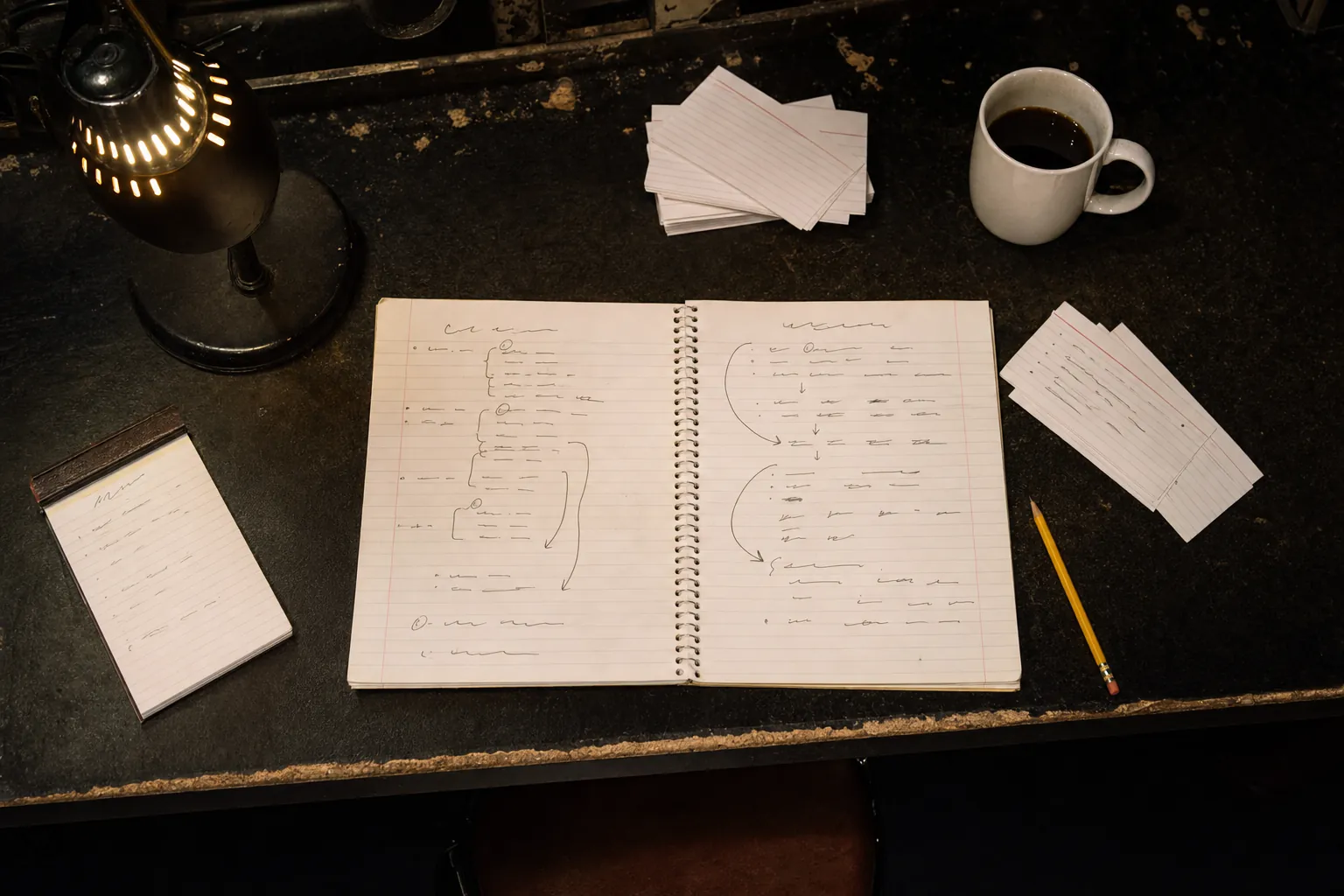
When you have several jokes or turns, put them on separate notes and try more than one order. A practical sequence often moves from the most understandable observation to the most personal or surprising one. You are looking for momentum: each beat should make the next beat easier to hear, not reset the room completely.
Look for repeated setup. If two jokes need the audience to understand the same strange work rule, explain that rule once, then let the next joke build on it. If you keep reintroducing the subject, the set will feel longer than it is. You can also group jokes by emotional direction. A set might begin with frustration, become more ridiculous, then end with the honest admission that you caused part of the problem.
Transitions deserve a quick edit too. You do not need a clever bridge between every joke. Often the best transition is a short sentence that gives the next beat its setting: “My family does the same thing,” or “My building has a version of that.” If the next joke has nothing to do with the previous one, acknowledge the turn cleanly instead of pretending the connection exists. A pause, a change in posture, or one plain sentence can reset the room better than a long explanation.
This does not mean every set needs one giant theme. A clean three-minute set can be three short jokes about different subjects. But when you are learning, connected material reduces the number of things you have to remember and gives the audience a clearer sense of who is holding the microphone. The stand-up styles guide is useful here because a story set, a one-liner run, and an observational set create momentum in different ways.
5. Rehearse for the ear, not for the page
Read the set aloud at a normal speaking pace. You will quickly find sentences that have too much information, jokes that need a pause, and details that only made sense because you could see the note in front of you. The goal is not to perform it like a robot in your living room. It is to hear the route clearly enough that you can keep your place when a real audience reacts.
Time one rehearsal, then use the result honestly. If the mic offers three minutes and your material takes five, do not hope adrenaline will turn you into a speed-reader. Cut the least useful explanation, the weakest repeated turn, or the side road that changes the subject. A shorter set with a true closer is better practice than a long set you have to abandon halfway through.
Say the important words where they can land. The final word of a punchline should not be lost under a second sentence explaining it. Record one run and listen back for your natural pauses. The National Comedy Center’s look at how comedy gets made treats writing, performance, and feedback as connected parts of the craft. Rehearsal is where the written version begins turning into something a room can hear.
6. Test the set with one question in mind
Your first performance is not a verdict on the whole set. Go in with a question. Maybe you want to know whether the opening premise is clear. Maybe the closer is new. Maybe a story has one detail you suspect is slowing it down. A specific question turns the next performance into useful information instead of a vague feeling that it went well or badly.
When a laugh happens, let it happen. When a line misses, keep moving. You can review it later. A quiet moment might mean the premise was unclear, the wording was crowded, the timing was rushed, or the angle simply needs more work. Do not try to solve all four possibilities in the moment. Note the exact place, then make one purposeful change before the next time you try it.
After the show, write three short notes before the feeling of the night takes over: what felt clear, where the room reacted, and what you will test next. Be concrete. “The audience was cold” is difficult to use. “The first work joke needed the rule explained before the comparison” gives you an edit. Keep the notes with the version of the set you performed, because a revision makes more sense when you can see what you actually said that night.
The first 30 days of stand-up guide can help you plan that first open-mic visit. Its main principle is worth keeping: a small, rehearsed set gives you more to learn from than a notebook full of material you have never said aloud.

Use Chuckle to keep studying and sharing the work
Watching a complete comedy moment can help you see how another performer gets into a premise, moves between beats, and lets a closer land. On Chuckle’s comedy feeds, pay attention to structure without trying to copy someone else’s voice. Notice how much context the clip gives you, which detail makes the premise clear, and whether the final beat changes the meaning of the opening.
When you have a clean, complete section of a set, you can give it a home on Chuckle’s comedian page. Fresh material that still needs repetitions can fit Open Mic. A more polished clip with a clear setup and turn can belong in Standup. The value is not pretending a new joke is perfect. It is keeping your work visible, organized, and ready for people who want to watch more of it.
A quick comedy-set checklist
- Choose one premise. Use a specific situation that can hold several laughs.
- Give the room the essential context. Let the unusual detail arrive early.
- Plan the route. Build a beginning, a few connected beats, and a real closer.
- Cut repeated setup. Explain the world once, then keep moving inside it.
- Rehearse out loud and time it. Edit for a listener, not a silent reader.
- Test one change at a time. Leave each performance with a useful next question.
A good first set does not need to prove that you have solved stand-up. It needs to show a real point of view, take the audience somewhere clear, and give you a better version to bring back next time. That is how three minutes becomes five, five becomes ten, and a pile of notes starts becoming material.
Frequently asked questions
Writing a comedy set FAQ
How long should my first comedy set be?
A short, focused set is enough. Three to five minutes gives you time to establish a point of view, develop one or two ideas, and finish with a real ending without asking a new audience to keep track of too much at once.
How many jokes do I need for a five-minute comedy set?
There is no useful universal number because stories, act-outs, and one-liners use time differently. Build around a few clear laugh opportunities, then rehearse aloud. If the set feels thin, add another honest angle on the same premise instead of piling on unrelated jokes.
Should a comedy set have one theme?
A shared theme helps early sets feel easier to remember and easier for an audience to follow. The theme can be as simple as one job, family habit, travel disaster, or dating experience. It does not have to be announced. It simply gives the jokes a natural connection.
What should I do if part of my set does not get a laugh?
Keep going, then review that moment after the show. Check whether the room had enough context, whether the key word arrived too early or too late, and whether the premise needs a more specific angle. Change one thing for the next attempt so you can learn what helped.