

Learning how to write jokes is less about waiting for a lightning bolt and more about giving a real observation somewhere to go. Notice the detail that bothers, surprises, or embarrasses you. Make the tension clear. Write more than one possible turn. Then say the best version out loud and let the rhythm tell you what the page cannot. That is a repeatable process, and it is how a vague funny thought becomes material you can use.
Start with a reaction, not a broad subject
“Dating,” “work,” and “my family” are subjects. They are not jokes yet. A useful starting point is a reaction to something more specific: the way a job application asks you to describe yourself as if you are a rescue dog, the friend who says they are “five minutes away” while still in the shower, or the restaurant menu that makes a burger sound like it needs a passport.
Specificity gives you images, stakes, and language. It also stops you from reaching immediately for the version of the topic everyone has already heard. Make a quick list of the things that feel ridiculous about the moment. What did you expect? What actually happened? What would make the situation worse? What detail would sound unbelievable if it were not true? Those questions turn an experience into raw material.
Write without editing for the first few minutes. A free-write can look messy because its job is to uncover the details you forgot were there. Comedians on the Loose suggests starting with the experience and the emotion behind it, then trimming later. That order matters. You need enough material on the page before you can decide what has a comic shape.
Give the audience one clear expectation
Most short jokes work because the audience makes a reasonable guess about where the thought is going, then the punchline makes them look at it another way. You do not need to announce the mechanics while you write, but it helps to know what the audience is being asked to believe before you change the direction.
That is the basic setup-and-punchline shape. The setup gives just enough information to create an expectation. The punchline changes the meaning, comparison, or consequence. Backstage describes the same structure as a setup that establishes the situation and a punchline that delivers the turn. A longer story can use that shape several times, with smaller laughs along the way.
Keep the setup honest and easy to follow. If the audience has to sort through five names, two time jumps, and a long explanation before they understand the situation, the turn has to work much harder. Start close to the unusual detail. The cleaner the road, the more room the surprise has to land.
Use five ways to find a turn
There is no single joke formula that fits every comic. A few prompts are useful because they stop you from staring at the same sentence and hoping it becomes funny. Pick one method at a time, write several options, and keep the versions that sound like you.
1. Exaggerate the consequence
Take the small irritation seriously enough to follow it into an absurd consequence. If your dentist sends too many reminder texts, imagine the final message arriving from a search-and-rescue team. The exaggeration works when it reveals how the situation already feels to you, not when it becomes random noise.
2. Compare it to a different world
Ask what the situation resembles when you say it plainly. A difficult self-checkout might feel like a hostage negotiation. A family group chat might feel like an emergency broadcast system with no emergency. A good comparison lets the audience borrow a familiar image, then notice the ridiculous overlap. The comparison exercise is especially useful when you make two quick lists of associations and look for the words they share.
3. Take the wording literally
Everyday phrases hide strange pictures. “Circle back,” “adulting,” “personal brand,” and “work family” all invite a literal version that may be funnier than the normal meaning. Ask what would happen if the phrase were true in the most inconvenient possible way. This is a simple route into wordplay without making the joke depend on a pun alone.
4. Reverse the status
Let the thing that sounds impressive reveal itself as pathetic, or let the supposedly embarrassing thing become the confident choice. A restaurant can call itself “exclusive” because it has only three tables and one is a storage closet. The reversal works because the audience recognizes the original claim, then sees the more honest version underneath it.
5. Name the real point of view
Sometimes the most useful turn is not a trick. It is the thing you actually think but were too polite to say in the first draft. In advice on joke writing from comedian Jenny Hagel, she stresses that a joke connects more when it carries the writer’s own point of view. You are not trying to sound universally funny. You are trying to make the audience recognize a perspective they did not expect to hear stated so clearly.
Write many endings before you pick one
The first punchline you write is often a sign that you found the premise, not proof that you found the best joke. Give yourself a number: five endings, ten comparisons, or ten ways to heighten the consequence. Some will be obvious. Some will be worse than silence. That is fine. The point is to get past the answer your brain produces first.
Keep the setup the same while you test endings. That makes it easier to see which turn has the cleanest surprise. You can also write tags, short extra laughs that build on the first punchline. A tag should not restart the joke. It should extend the image, raise the stakes, or reveal one more angle before you move on.

Put the important word close to the laugh
Jokes get weaker when the audience has to hold the key information for too long. If the point of the joke is that your neighbor is a former magician, the audience needs that detail close enough to the punchline for the connection to arrive immediately. If it appears several sentences earlier, the room may understand the sentence but miss the turn.
Cut the part that explains what the audience already understands. Move the sharp noun or image later in the sentence when it helps the reveal. Hagel’s concise advice is useful here: extra words make the punchline heavier, while a tighter version gives the laugh a cleaner landing. This does not mean every joke should be fast. It means every word should earn the time it takes to say it.
Read the setup once and underline the detail the punchline needs. If that detail is buried, move it. If it appears twice, keep the better version. If the punchline arrives before the audience has the information to understand it, add one clear fact and remove something less useful.
Say the joke out loud before you trust it
Stand-up lives in the ear. A line that looks perfectly organized on a screen can feel slow, stiff, or confusing when you say it at conversational speed. Read the joke aloud, then listen for the place where you naturally want to pause. That pause may be part of the laugh. It may also show that the setup needs a cleaner sentence.
Record one rehearsal. You are not looking for a flawless performance in your bedroom. You are listening for where you rush, where you add needless explanation, and where the final word gets lost. Do not perform punctuation. Know the thought, the turn, and the key image. That gives you room to sound present instead of reciting something you wrote in a different voice.
The National Comedy Center treats writing, performance, and feedback as connected parts of the creative process. That is a useful way to think about a new joke too. The page creates the first version, your voice finds the rhythm, and an audience tells you what they actually heard.
Turn good jokes into stand-up material
One joke can be enough for a quick clip or a strong opening line. A useful stand-up bit usually grows from a premise that can support more than one turn. Once you have a joke that reveals your point of view, ask what else belongs in that world. What is the next consequence? What is a more personal example? What happens when the logic goes one step farther?
That is how you move from a good line to a sequence without padding it. The guide to writing stand-up comedy walks through turning a premise into beats, tags, and a complete bit. When you are ready to test it, the first 30 days of stand-up guide covers the practical side of trying it at an open mic and revising from the response.
Keep a small log after each attempt. Note the version you used, the part that got attention, and one change you want to try next. The useful outcome is not “this joke worked” or “this joke failed.” It is a clearer next question: shorten the setup, write a better ending, move the key word, or try a different angle.
Use Chuckle to keep studying the craft
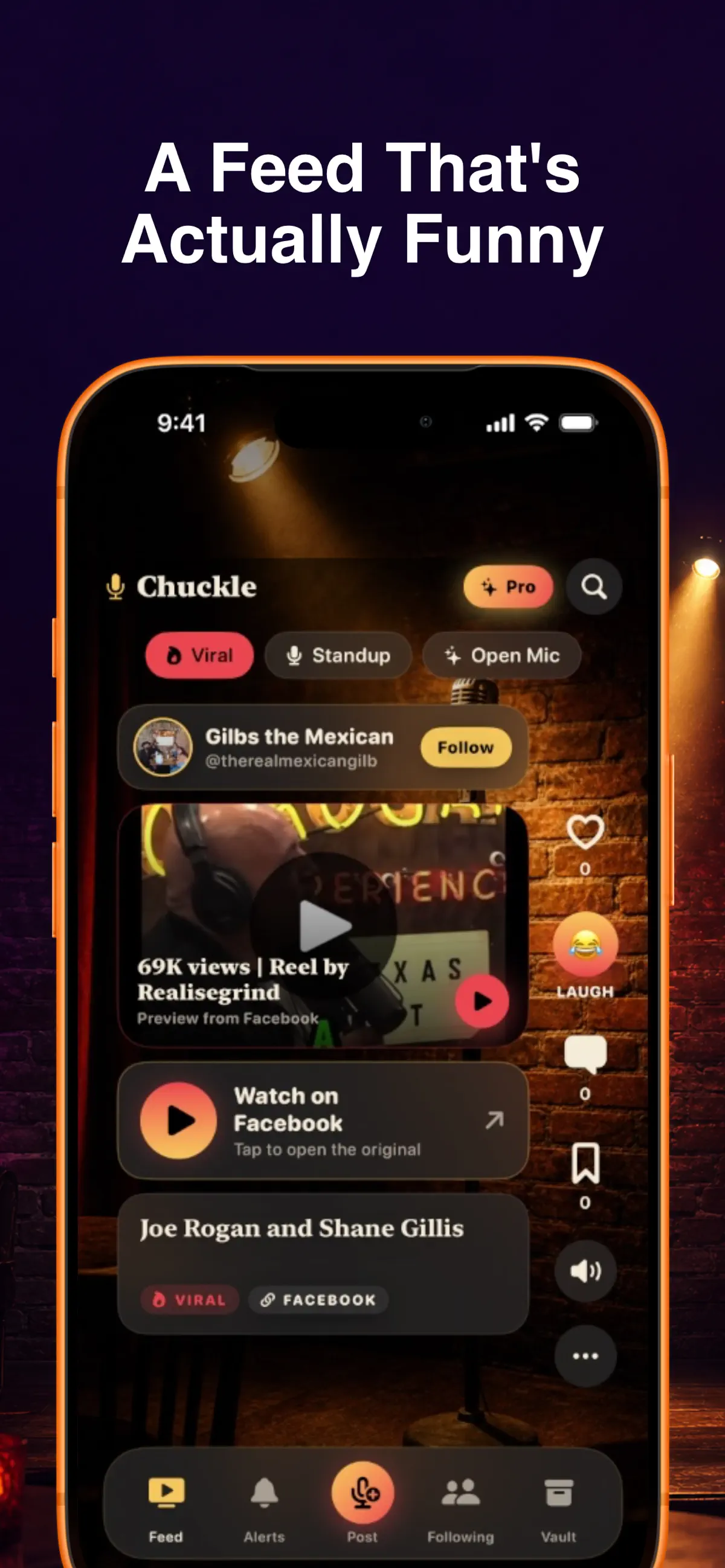
Watching comedy closely can make your own writing more precise. On Chuckle’s comedy feeds, notice how a comic gets a viewer into the premise, how long they wait before the turn, and what they leave out. Do not copy the joke. Borrow the habit of paying attention to the choices that make a moment understandable and surprising.
When you have a clean, complete moment you are ready to share, Chuckle’s comedian posting path gives you a home for it. Fresh material can live in Open Mic while you keep learning from it. A bit with a clear setup and a confident turn can take its place in Standup. The aim is not to pretend every idea is finished. It is to keep making, testing, and finding the version that feels most like you.
A quick joke-writing checklist
- Start with one specific reaction. The strange detail is usually more useful than the broad topic.
- Make the expectation clear. Give the audience a simple road before you change direction.
- Write multiple turns. Use exaggeration, comparison, literal language, reversal, or your real point of view.
- Keep the key detail near the punchline. Do not make the audience carry the important information too far.
- Say it out loud. Edit for rhythm, breath, and the words that need to land.
- Test one revision at a time. Let each performance tell you what to try next.
Joke writing gets less mysterious when you treat it as a set of choices. Start from something real, give it a clean shape, try several turns, and listen for the version that sounds most like you. Then write the next one.
Frequently asked questions
Writing jokes FAQ
Do stand-up jokes always need a setup and punchline?
A clean setup and punchline is a useful starting shape, especially when you are learning. Longer stories, act-outs, and crowd work can use more moving parts, but they still need to guide the audience toward an expectation and then change that expectation in a satisfying way.
How many jokes should I write from one premise?
Write more than you expect to keep. Ten possible turns, comparisons, or endings can reveal two useful choices that would not have appeared if you stopped at the first decent line. The goal is not to make all ten good. It is to give yourself options.
What if I cannot think of a punchline?
Return to the premise and make it more specific. List what is odd about the situation, what you expected to happen, what the most dramatic consequence would be, and what it resembles. A punchline often appears after you have named the tension clearly enough.
How do I know whether a joke is ready for an open mic?
You do not need proof that a joke will work before you perform it. You need a clear premise, an ending you can say without reading, and one specific thing you want to learn from the room. Treat the first attempt as information, then revise from what you heard.