


To do stand-up comedy for the first time, write a short set around one clear idea, rehearse it aloud, take it to an open mic, and use what the room gives you to shape the next version. You do not need a finished hour, a perfect stage persona, or a story about being funny since kindergarten. You need a small piece of material you understand, a room where you can try it, and a way to learn from what actually happens. The first set is not an audition for whether you are allowed to keep going. It is the first useful version of the work.
1. Start with a small, specific point of view
Begin with something you can describe clearly: a family rule that makes no sense, a terrible customer-service ritual, a roommate habit, an inconvenient part of your job, or a situation you keep replaying because the logic was so strange. The most workable early premises are close enough to your real experience that you already know the details.
Do not start by trying to sound like a comedian. Start by writing the plain version of what happened, then ask what is odd, unfair, backward, or unexpectedly serious about it. A stand-up premise gives the audience a shared picture before it asks them to follow a turn. The more specific the picture, the less explanation you need on stage.
If your subject is still broad, use the process in this stand-up writing guide to turn it into a premise, several possible punchlines, and a bit you can say out loud. You are looking for a version that sounds like a real observation, not an impressive sentence on paper.
2. Write more turns than you plan to perform
A first set becomes easier when every idea has more than one possible direction. After your setup, write several turns: a comparison, a stronger image, a reversal, an exaggerated consequence, or the honest thing you were too polite to say in the moment. Most of those lines will not be the final version. That is normal. Their job is to show you where the point of view has energy.
Read the options aloud as soon as possible. A line that looks tidy on a screen can become long, stiff, or confusing when it has to travel through a microphone. Mark the version that is easiest to understand on the first listen, then keep one alternate tag in your notes in case the idea opens up later.
For a more focused writing session, build jokes from setups and turns rather than waiting for a fully formed punchline to arrive. The useful goal is a few promising laughs, not a stack of pages you are afraid to cut.

3. Shape a short set with a beginning and an exit
New comics often arrive with individual jokes but no route through them. Give the set a simple shape. Open with the clearest premise, follow it with one or two ideas that live in the same world, and end on the line that feels most complete. You do not need a grand theme. You do need to know what comes next when the nerves make your mind go blank.
Use beats instead of trying to memorize a page word for word. A beat might be “bad apartment tour,” “landlord’s explanation,” “kitchen surprise,” and “callback.” When you know the purpose of each beat, you can lose a word without losing the set. You will sound more present because you are explaining a story or thought, not reciting a document.
Keep the first version short enough that you can rehearse it several times without resenting it. This guide to building a comedy set can help you put the material in an order that earns the room’s attention before you ask them to stay for a longer idea.
4. Rehearse aloud before you need courage
Read the set standing up, at the pace you expect to use on stage. The goal is not to perform for an imaginary standing ovation in your bedroom. It is to find the sentences your mouth wants to simplify, the places where a setup takes too long, and the moments where a pause makes the image clearer. A joke is a sound before it is a paragraph.
Practice from your beat list as well as from the full draft. Say the opening, then look away from the notes and find the next idea in your own language. When you can recover without panicking, you have built something much more useful than perfect memorization. You are teaching yourself that a missed word does not end the set.
Time a few run-throughs, but do not race to make the number smaller. Cut only the parts that do not improve the picture, add a turn, or set up a later callback. A short set should have air in it. You need room to greet the audience, let a laugh happen, and take a breath before a line that matters.
5. Find an open mic that matches the stage you are on
Look for a recurring open mic at a comedy club, theater, coffeehouse, or bar, then learn the practical rules before you show up. Find out whether you sign up online or in person, how much time performers receive, whether the room starts on time, and whether there are any rules about recording. A first mic feels less mysterious when you know the simple logistics.
Arrive early enough to hear the host, see how the microphone works, and notice the room. Is the audience close? Are people seated and listening, or moving around a bar? Are most performers new? None of those details require you to change who you are. They help you speak clearly, choose the amount of context a joke needs, and avoid treating the first minute like a sprint.
Stand-up has changed rooms, audiences, and screens many times. The National Comedy Center’s comedy archive preserves that history, while the Library of Congress collection on comedy shows how seriously performance records and comic voices are worth keeping. Your first room will be small compared with that history, which is exactly why it is a good place to learn the basics.

6. Perform the version you prepared, then listen
When your name is called, get the microphone to a usable height, take a breath, and start with the premise you can say most clearly. You do not need to announce that it is your first time unless that is part of the bit. Let the audience meet the material before you start explaining your nerves.
Give the room time to hear the setup and finish a laugh before you continue. Rushing is one of the most common ways a workable joke becomes hard to follow. A pause is not dead air when the audience is responding. It is part of the rhythm. If a joke is quiet, do not argue with the silence or explain the punchline. Continue into the next beat with the same calm pace.
The goal is not to dominate the room on the first attempt. The goal is to learn what you can actually repeat: which premise got attention, where the words crowded together, which image made people picture the situation, and whether the closer left you with a clean ending. For more on the onstage part, use these stand-up comedy tips before your next mic.
7. Review the set with one question at a time
After the set, write down the facts while they are still real. Note the order of the material, the room, where you felt rushed, and what surprised you. If you recorded the performance with the venue’s permission, listen once for the audience response before judging your delivery. You are looking for evidence, not a reason to call the whole night a success or a disaster.
Choose one question for the next performance. Did the audience need the location sooner? Would the image be stronger with one exact detail? Did you step on a laugh? Is the closer better as a callback? Changing one thing at a time lets you learn what helped. Rewriting every line after one quiet room makes it nearly impossible to tell why the next version worked or did not.
Keep a simple record of your experiments. A useful note is “shorten the setup before the second turn,” not “be funnier.” The first note leads to an action. The second only gives you something vague to worry about.
It also helps to separate a rough room from a rough bit. Sometimes the audience is distracted, the sound is difficult, or the order runs long. That does not mean you ignore a quiet response. It means you give a promising premise more than one honest test before deciding what it can become. Repetition is how a line proves whether it works, and how you learn which changes are actually yours to make.
8. Let your style develop from the material that works
You do not need to choose a permanent comedy identity before your first open mic. A storyteller, a one-liner comic, and a crowd-work performer can all begin by learning how a premise turns into a laugh. Your preferences will become clearer when you notice what you enjoy writing and what the room responds to when you perform it.
Pay attention to the material you want to revisit. Do you like building a scene? Do you enjoy finding one sharp sentence? Are you strongest when you take an everyday rule seriously enough to expose how ridiculous it is? The main stand-up comedy styles are a useful map, but they are not a test you have to pass. Let the work tell you which tools you want to develop.
9. Share a clip when it gives a new viewer enough context
Not every early set needs to be posted. When you do have a short moment that shows your point of view, choose the version with enough setup for someone who was not in the room to understand the laugh. A clip can be a strong punchline, a concise story turn, or a crowd-work exchange where the question is clear.
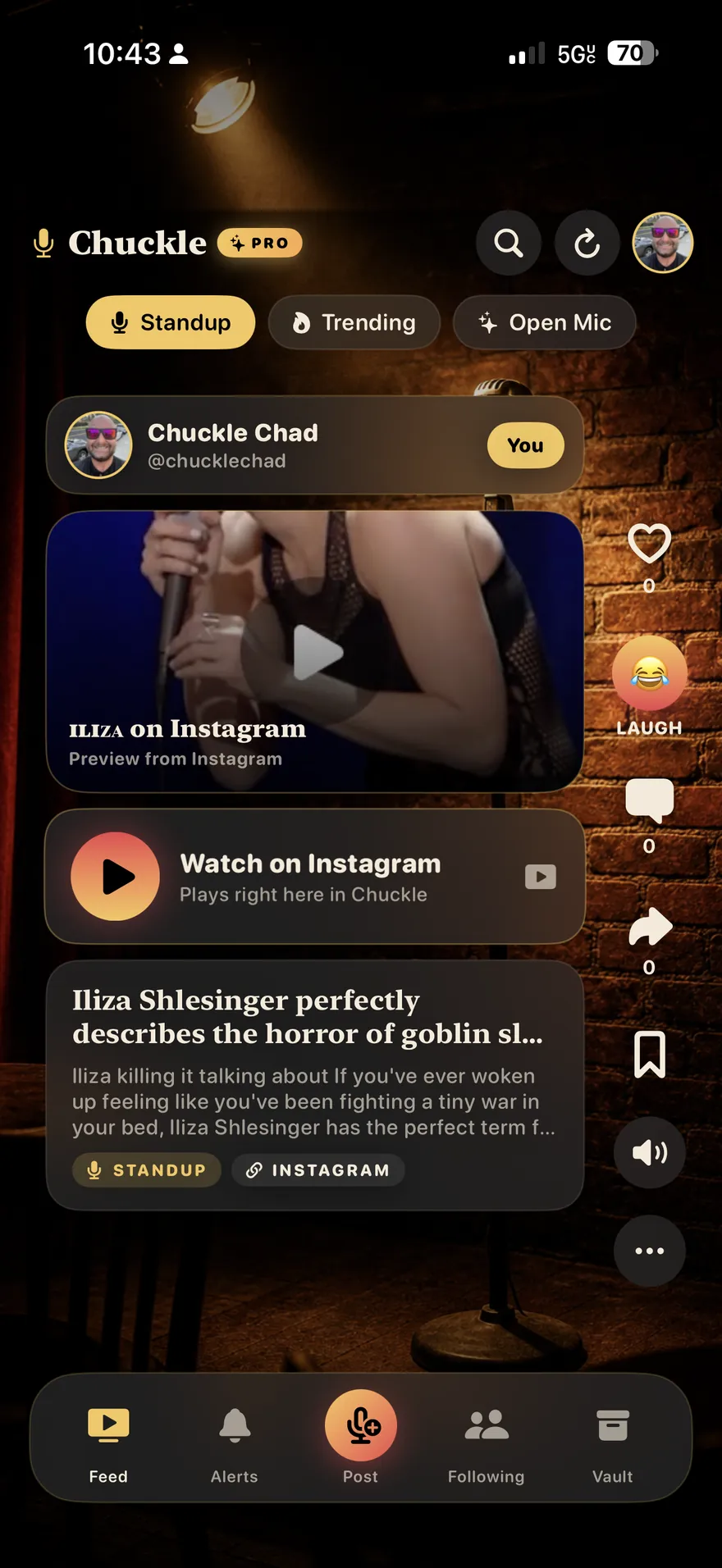
Chuckle gives comedians a comedy-first place to title a clip, add helpful context, choose the right feed, and keep the work together on a profile. The Open Mic feed is a natural place for material you are still learning from, while Standup fits a bit that has found its shape. The point is not to pretend the work is finished. It is to make a good moment easier for the next person to understand and follow.

A first open mic checklist
- Prepare the right amount of material. Know the time limit and keep a little room for a natural pause or introduction.
- Know the beats. Memorize the route through the set, not only the exact wording.
- Arrive early. Learn the sign-up process, listen to the host, and see how the room feels.
- Speak to the room you have. Give the setup enough context and leave space for people to hear the turn.
- Write one useful note afterward. Carry a specific revision into the next performance.
That is how to do stand-up comedy at the beginning: write a small honest piece, put it in front of people, and make the next version a little clearer. The work gets less mysterious when you keep returning to that loop.
Frequently asked questions
How long should my first stand-up set be?
Start with the time the open mic actually gives you, often a few minutes, and prepare material that comfortably fits inside it. A short set with a clear beginning, a few connected laughs, and an ending is more useful than trying to force every idea you have into one appearance.
Do I need to be naturally confident to do stand-up comedy?
No. Confidence grows from preparation and repetition. Know the essential beats of your set, arrive early enough to understand the room, and give yourself one practical goal for the night. You do not need to feel fearless to take the stage prepared.
What should I do if nobody laughs at my first open mic?
Finish the set, write down what you noticed, and choose one small change to test next time. A quiet response can mean the room needed more context, the wording was crowded, the order was off, or the premise needs a different angle. It is information about that version of the material, not a final judgment on you.
How often should a new comedian perform?
Choose a pace you can sustain while still writing and reviewing what happened. One or two open mics a week can create useful momentum when each performance has a clear purpose, such as testing a new opener, slowing down a setup, or trying a revised ending.